Breaking the Silence
Speech therapy for non-verbal children isn’t just about "teaching words." It is about building a bridge between a child’s inner world and the people around them.
3/8/20262 min read

Breaking the Silence: How Speech Therapy Empowers Non-Verbal Children
For many parents, the dream isn’t necessarily for their child to give a graduation speech—it’s simply to hear them say "I’m hungry," "I love you," or "My toy is broken." When a child is non-verbal, the world can feel like a place of constant barriers. However, being non-verbal does not mean a child has nothing to say.
Speech therapy for non-verbal children isn’t just about "teaching words." It is about building a bridge between a child’s inner world and the people around them. Here is how professional intervention and home support can transform the lives of non-verbal learners.
Understanding the Non-Verbal Journey
Every child’s path is unique. Some children may have a diagnosis of Autism Spectrum Disorder (ASD), while others may face Apraxia of speech or developmental delays. The goal of a Speech-Language Pathologist (SLP) is to identify the specific hurdles and find the "key" that unlocks that child’s communication.
The first step in speech therapy is rarely vocalization. Instead, it focuses on pre-linguistic skills, such as:
Joint Attention: Looking at the same object as another person.
Cause and Effect: Understanding that an action (pointing) leads to a result (getting a snack).
Imitation: Copying gestures, facial expressions, or sounds.
Beyond Talking: The Power of AAC
A common misconception is that using alternative tools will prevent a child from ever speaking. In reality, the opposite is often true. Augmentative and Alternative Communication (AAC) provides a "voice" while the child works on the physical or neurological aspects of speech.
Common AAC methods include:
PECS (Picture Exchange Communication System): Using physical icons to request items.
High-Tech Devices: Tablets with specialized apps that speak words when an icon is pressed.
Sign Language: Using manual signs to represent core needs.
By reducing the frustration of being misunderstood, AAC lowers stress levels, which often creates a more "speech-ready" environment for the child.
Strategic Play: Therapy in Disguise
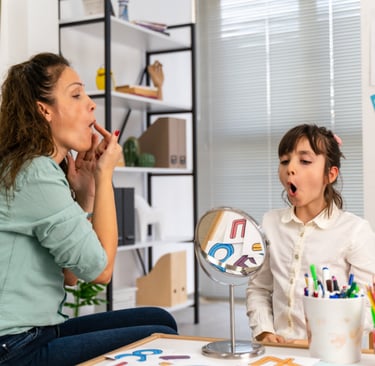
Professional speech therapy for non-verbal kids often looks like "just playing." But there is a science to the fun. Therapists use Naturalistic Developmental Behavioral Interventions to encourage communication during activities the child already enjoys.
If a child loves bubbles, the therapist might blow them, close the lid, and wait. This "communicative temptation" encourages the child to make a sound, a gesture, or a sign to ask for "more." It turns communication into a rewarding game rather than a stressful chore.
How Parents Can Support Progress at Home
While the clinic is important, the real magic happens in the living room. Parents are the primary "communication partners." You can support your child by:
Narrating the Day: Act like a sports commentator. "I am pouring the milk. The milk is cold. Now we drink!" This builds their receptive vocabulary.
Modeling AAC: If your child has a communication board, use it yourself. Show them how you use the icons to express your own thoughts.
Honoring All Attempts: If your child pulls your hand toward the fridge, acknowledge it. "Oh, you are showing me you want juice!" This reinforces that their effort to communicate worked.
The Path Forward
Supporting a non-verbal child is a marathon, not a sprint. Success isn't always measured in sentences; sometimes, it’s measured in a first-ever meaningful look, a pointed finger, or a smile when they finally get exactly what they asked for.
With the right speech therapy approach, we can move past the silence and start listening to what these incredible children have been trying to tell us all along.